Can Your Usage-Based Revenue Recognition Survive an Audit?


Auditors do not just check whether your numbers are correct. Auditors check whether you can prove they are correct. In a subscription model, the proof is straightforward: a signed contract, a predictable billing schedule, a recognition policy that maps cleanly to ASC 606.
Usage-based revenue recognition breaks every one of those assumptions. The performance obligation is satisfied variably. The transaction price depends on consumption data that changes daily. The judgment calls that drive recognition live in spreadsheets and tribal knowledge, not in traceable systems.
The audit risk is not that the numbers are wrong. The risk is that no one can demonstrate why they are right.
Why subscription audit trails do not translate
Subscription revenue recognition follows a predictable pattern. A customer signs a $200K contract on a 12-month term. The finance team recognizes $16,667 per month on a straight-line basis. The auditor traces from the contract to the recognition schedule to the GL entry. Every step is documented and reviewable.
Usage-based and consumption models break that predictability at every level.
Variable obligations and the as-invoiced expedient
Under ASC 606, revenue recognition requires identifying performance obligations, determining the transaction price, and recognizing revenue as obligations are satisfied. In a subscription model, these steps are largely mechanical. In a usage-based model, each step requires judgment.
ASC 606 offers one simplification for metered revenue: the as-invoiced practical expedient (ASC 606-10-55-18). When the amount invoiced corresponds directly to the value transferred, revenue can be recognized equal to the invoiced amount. Pure pay-as-you-go pricing at a flat per-unit rate qualifies.
But the expedient breaks the moment pricing stops corresponding directly to value. Declining-rate tiers, prepaid credit discounts, minimum commitments with overage, and retroactive volume rebates all disqualify a contract. Most usage-based companies operate on the hard side of that line. Full variable consideration estimation is required, and the audit burden grows with it.
The trail runs through systems that do not connect
Auditors at major accounting firms have flagged usage-based revenue recognition as a critical audit matter. The reason is structural. The recognition process runs through multiple IT systems. Metering platforms capture consumption. Billing engines rate usage. CRMs hold contract terms. ERPs post journal entries.
Each system holds a piece of the story. None tells the whole story on its own. The systems were never designed to produce a unified audit trail. When an auditor asks how a customer's recognized revenue was calculated, the answer requires pulling data from several systems. The reconciliation is almost always manual. The audit trail exists, but assembling it is a project, not a query. Getting cross-silo visibility into the full recognition chain requires stitching together data that no single system owns.
Where audit risk concentrates in usage-based recognition
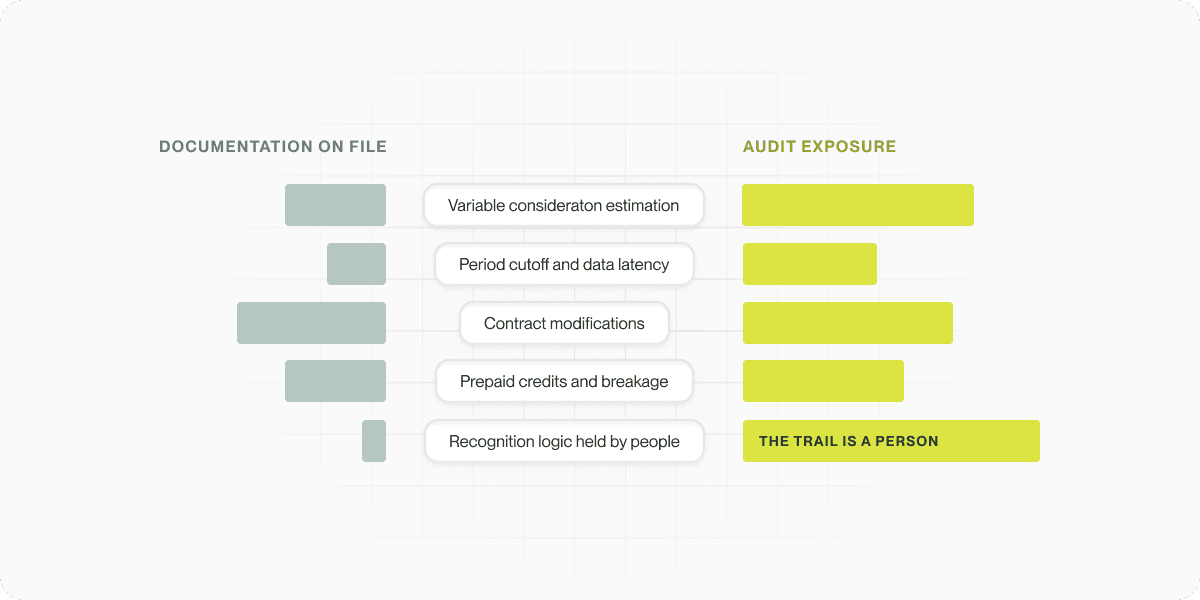
Audit risk does not distribute evenly across the recognition process. Several specific areas carry disproportionate exposure, and each one demands documentation most finance teams do not have.
Variable consideration estimates auditors cannot verify
ASC 606 requires companies to estimate variable consideration using one of two methods. Expected value calculates a probability-weighted average across possible outcomes. Most likely amount identifies the single most probable outcome. The estimate is then subject to the constraint: only include amounts where a significant reversal is highly probable not to occur.
For usage-based contracts, variable consideration is the revenue. Every overage estimate, every tiered pricing calculation, every prepaid credit drawdown involves judgment. Auditors expect that judgment to be documented: the method chosen, the inputs used, the rationale applied. When those decisions live in a controller's head or a spreadsheet formula with no trail, the auditor cannot verify the logic.
The finding is not that the estimate was wrong. The finding is that the estimate was not provably right.
Data latency and period cutoff failures
Usage events do not always reach the billing system in real time. When a consumption event occurs in one period but processing happens in the next, revenue attribution breaks. The auditor tests cutoff by checking whether revenue landed in the correct period.
Finance teams need a documented policy for attributing usage to the consumption date, not the processing date. Without that policy enforced, cutoff errors accumulate. Each one is an audit finding. At scale, they erode confidence in the entire recognition process.
Contract modifications with no recognition update
Usage-based contracts get modified frequently. Customers renegotiate pricing tiers, adjust committed minimums, or add new products. Under ASC 606, each modification requires evaluation. Does the modification create a new contract, or does it change the existing one? Recognition treatment adjusts accordingly.
In practice, the sales team updates the CRM. The billing team may or may not update the invoice logic. The revenue schedule in the ERP often remains untouched until someone catches the discrepancy during close, or during the audit. Auditors testing modifications routinely find that recognition treatment does not reflect the current terms.
Prepaid credits and breakage exposure
Prepaid credits create a contract liability when sold. Revenue is recognized as credits are consumed. The audit question is what happens to credits that expire unused.
ASC 606 provides two approaches to breakage. The proportional method recognizes breakage revenue in proportion to credits actually redeemed, supported by historical redemption data. The remote method recognizes breakage only when the likelihood of redemption becomes remote. Companies without redemption history to support their estimates face a documentation gap auditors flag.
A further complication arises when credits are sold at a discount. The discount may constitute a material right under ASC 606, requiring separate allocation and recognition. Auditors test whether the breakage policy is supportable and whether material rights have been properly identified.
Recognition logic that lives in people, not systems
The most dangerous audit vulnerability does not show up in a specific test. Sometimes the judgment calls powering recognition live entirely in one controller's memory. How to allocate SSP for a product bundle. How to treat a mid-period modification. How to constrain variable consideration for a new tier.
When that happens, the audit trail is a person. When that person is unavailable, the trail goes cold.
Why audit prep compounds with scale
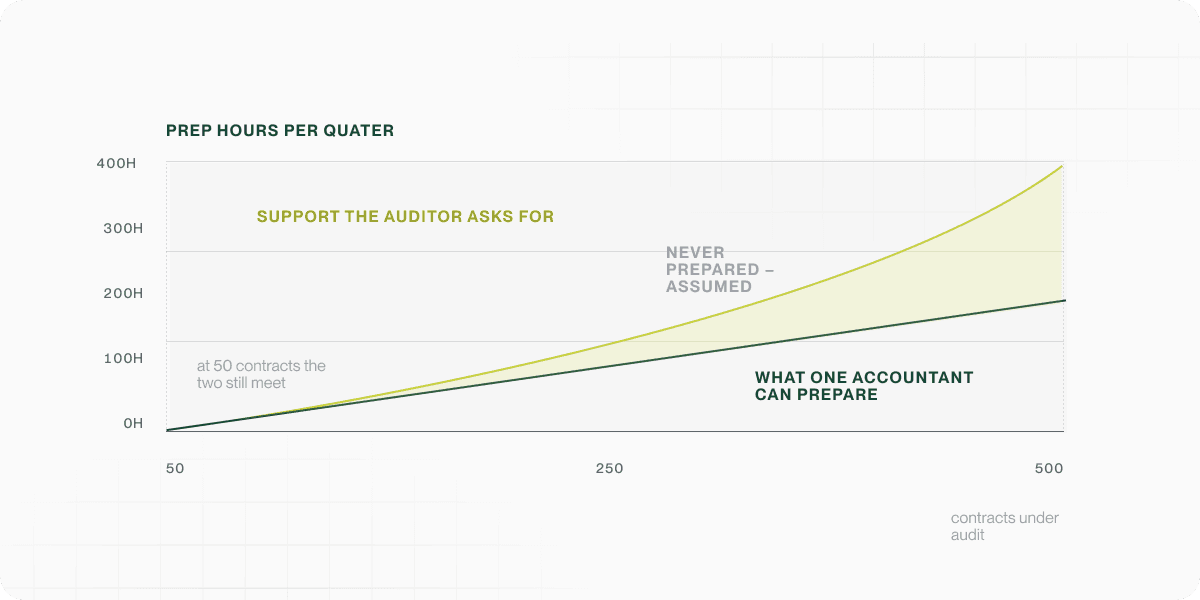
Audit risk in usage-based recognition does not stay flat as the business grows. Every new contract, every modification, every new entity adds another node the auditor needs to trace.
Manual audit prep does not keep pace with contract volume
At 50 usage-based contracts, a senior accountant can manually prepare the support an auditor needs. At 500 contracts with varying pricing tiers, modification histories, and consumption patterns, that preparation requires weeks. The gap between prep capacity and audit scope widens with every contract signed. The finance team spends more time each quarter assembling documentation than actually closing the books.
Knowledge concentration creates fragility
The person who knows how a specific customer's usage converts to recognized revenue is often one controller. That knowledge is not documented in a way that survives a departure. When the person leaves, the next audit cycle becomes a reconstruction project. Maintaining reporting accuracy under those conditions requires heroics, not process.
What audit-ready usage recognition actually requires
Closing the audit readiness gap requires changing how recognition logic is built and documented. Adding another layer of prep work after the fact does not solve the structural problem.
Traceability from consumption event to journal entry
Every recognition decision needs to trace from the raw consumption event through the billing calculation to the journal entry. The policy logic should be visible at each step. When an auditor asks why a particular amount was recognized in a given period, the answer should take minutes to retrieve. Not days to assemble.
Audit trail as a byproduct, not a reconstruction
The key architectural shift is making the audit trail a byproduct of the recognition process itself. The trail should generate as recognition happens, not get reconstructed during audit prep. When recognition and auditability run on the same underlying context, documentation does not degrade as volume grows. The tenth audit is cleaner than the first.
From audit prep to audit-ready by default
A finance function that is audit-ready by default does not just reduce audit risk. Audit readiness changes what the finance team spends its time on. The weeks currently spent assembling support become weeks available for analysis and planning. That is the capacity the CFO actually needs.
Maximor makes recognition audit-ready by default. The platform layers on top of the ERP a company already has. Maximor learns how the finance function works from the team's existing output. Every recognition decision traces to logic an auditor can read without a guided walkthrough. Variable consideration estimates, breakage policies, and modification treatments all carry documentation the auditor can verify independently. Policy decisions are encoded in the platform, not memorized by the team.
For finance teams where audit prep has become a quarter-long project, one question clarifies whether a platform will help or add more work. Does the platform learn how your company runs finance, or does your team still have to teach it?
Frequently asked questions
Why is usage-based revenue recognition a critical audit matter?
Usage-based revenue recognition involves high transaction volumes, multiple IT systems, variable consideration estimates, and judgment-intensive ASC 606 decisions. Auditors at major accounting firms have repeatedly flagged these characteristics as creating elevated audit risk. The number of IT applications involved in the revenue cycle often requires auditors to bring in specialized IT professionals to evaluate controls.
What is the as-invoiced practical expedient and when does it apply?
The as-invoiced practical expedient (ASC 606-10-55-18) allows companies to recognize revenue equal to the amount they have the right to invoice, when that amount corresponds directly to the value transferred. Pure pay-as-you-go pricing at a flat per-unit rate qualifies. Contracts with declining-rate tiers, prepaid credit discounts, minimum commitments, or retroactive volume rebates do not qualify.
How do contract modifications create audit exposure?
Under ASC 606, each contract modification must be evaluated for its impact on performance obligations, transaction price, and recognition timing. In usage-based businesses, modifications happen frequently. When the revenue schedule is not updated to reflect new terms, the auditor finds a gap between the current contract and the revenue on the books.
What is breakage accounting for prepaid credits?
Breakage is revenue from prepaid credits that expire without being consumed. ASC 606 provides two methods: the proportional method recognizes breakage in proportion to credits actually redeemed, using historical data, while the remote method recognizes breakage only when redemption likelihood becomes remote. Credits sold at a discount may also create a material right requiring separate accounting treatment under ASC 606.
How does scaling affect audit readiness for usage-based companies?
More contracts, modifications, and entities multiply the nodes an auditor must trace. Manual audit prep scales linearly with contract volume while recognition complexity grows exponentially. Teams that prepare audit support manually spend progressively more time on preparation and less on analysis each quarter.
Can a company improve audit readiness without replacing its ERP?
Yes. The requirement is a reconciliation layer that connects metering data, billing logic, contract terms, and revenue schedules into one traceable model. That layer sits on top of the existing ERP. Platforms that learn a company's recognition logic from its existing work close the gap without rip-and-replace implementations.