How Kiteworks Automates 98% of Cash Transactions with Maximor

How Kiteworks Automates 98% of Cash Transactions with Maximor

How Kiteworks Automates 98% of Cash Transactions with Maximor

Platform/Revenue automation

Contracts in.
Audit-ready revenue out.

Maximor reads every contract the moment it closes, allocates SSP,
builds the revenue and deferred schedules, and drafts the entries
with reasoning attached. Your team approves. Your ERP stays put.

How does Maximor recognize revenue on a new contract?
01Review contract info
Term36 months Total$430,380 TermsNet 30 Clause cited on every value

Parsed, extracted, editable until you approve it.

02Define POBs
POB 1Point-in-time POB 2Over a period

Contract items become obligations, many to one.

03Allocate transaction price
$430,380transaction price

A standalone selling price for every obligation.

04Events
On acceptanceCompleted RatableActive Usage-basedActive Milestone-based15%

Each obligation recognises when it is triggered.

05Recognise revenue

Revenue posts, and the deferred balance unwinds.

Recognise revenue

Step five, where the schedule
meets the ledger

Revenue posts month by month, and the deferred balance rolls forward
behind it, per obligation, with every exception surfaced.

Review contract info Define POBs Allocate price Events 5Recognise revenue
Revenue waterfallAll obligations
$2M$1M0
548k786k480k1.52M1.74M
JulAugSepOctNovDecJanFebMarAprMayJun
Deferred revenueRoll-forward
Per obligationSepOctNov
POB 1Point-in-time
Starting balance
Billing
Recognised
Adjustments−$17.87
Ending balance
POB 2Over a period
The one balance that does not tie is raised, not buried.
The audit file

Your questions, answered
against the contract

Twenty-one items across the five steps, written in your language.
Agents work through every one as the revenue is booked.

ASC 606 checklist21 itemsversion 4
1Identify the contract
Approved, and both parties are committed to perform Each party’s rights to the goods or services are identifiable Payment terms are identifiable The contract has commercial substance Collection of substantially all consideration is probable
2Identify the performance obligations 3Determine transaction price 4Allocate transaction price 5Recognise revenue +Contract modifications
Answered, with its source Waiting on a person Version history
  • Every answer shows its sourceThe conclusion, the reasoning, and the schedule and page behind it.
  • You own the questionsAdd, edit or retire any of them. Every change is a kept version.
  • Written as the work happensBy the time fieldwork starts, the file already exists.
Human in the loop

The product lives in the remaining 1%

Autonomy gets you to 99%. Everything a finance team is actually accountable for happens in the last 1%.

99%runs without a personreading contracts, building schedules, drafting entries 1%
  • 01 Know when to stop A term the policy does not cover halts the run instead of being guessed at.
  • 02 What to escalate Only the judgment call is raised, with the contract and the guidance attached.
  • 03 Whom to bring in It goes to the reviewer who signs that kind of deal off, not to a shared queue.
  • 04 How to show the work The decision, its reasoning and its source stay on the entry for the audit.
Built for modern finance teams

Every step of revenue, handled

From the deal closing in your CRM to the entry sitting in the ledger, with the reasoning attached at every step.

OrderAdd-onDe-book

Contract ingestion

Contracts, orders and amendments pulled straight from the systems your team already signs in.

Contract end12-31-2028 Payment termsNet 30

Terms extraction

Obligations and billing terms lifted out of the document, each with the clause it was read from.

Over-period-of-timeRatable, 36 months

Schedule automation

Revenue and deferred schedules built for every obligation, no spreadsheets.

2.1 2.2 2.3Inconclusive

Audit memo drafts

The 606 checklist and its analysis, written as the revenue is booked rather than assembled before fieldwork.

CRM ERP Billing

Reconciliations and controls

Continuous reconciliations against your CRM, ERP and billing systems, with the checks run as contracts land.

Needs approval

Exception workflow

Outliers flagged and routed to reviewers, with the reasoning already attached.

RecognisedDeferred

CFO dashboards

Dashboards that update as entries post, every figure traceable to the entry behind it.

See how Maximor would read your contracts, on your ERP, with your policies.

Close faster, with greater agility

Revenue close drops from 5+ days to 1 to 2, because the schedules and the entries are already drafted when the period ends.

51-2
Days to close revenue
Audit-ready by design

100% of contracts prepared with their schedules and their 606 checklist, so the file an auditor asks for exists before they ask for it.

100%
Contracts prepared with their checklist
Investor-grade confidence

Numbers a board can trust, because every figure traces to the entry behind it and every judgment call carries its reasoning.

Valuation
Risk from a missed term, removed
Integrations

Revenue does not live in one system.

Maximor reads the contract you signed, what the customer consumed and what you invoiced, then writes the finished revenue back to your ledger.

Maximor works with
SalesforceSalesforceHubSpotHubSpotDocuSignDocuSignIroncladIroncladGoogle DriveGoogle DriveBoxBoxSharePointSharePointStripeStripeChargebeeChargebeeZone BillingZone BillingSnowflakeSnowflakeMetronomeMetronomeNetSuiteNetSuiteSAPSAPOracleOracleSage IntacctSage IntacctQuickBooksQuickBooksCampfireCampfireExcelExcel& more

Already running NetSuite's revenue module? Maximor can replace it, or run alongside it and reconcile against it.

4 days

To close, with audit-ready
ASC 606 schedules.

“Maximor automated our ASC 606 revenue recognition end-to-end. We now close in 4 days with audit-ready schedules and usage-based billing.”

Dipen Mehta
Dipen MehtaCFO / COO, Invst
FAQ

Revenue recognition, answered

What does Maximor actually do for revenue recognition?

+
It runs the whole ASC 606 process, from picking the deal up in your CRM and reading the contract behind it to drafting the journal entries. Agents pull the terms out of the contract, work out what you promised to deliver, split the contract price across those items, build the revenue and deferred revenue schedules, then hand you entries to approve. Your ERP stays the system of record.

What does Maximor pull out of a contract?

+
The things that decide how revenue gets recognised: line items, start and end dates, term length, what you promised to deliver, non-standard terms, and the pricing mechanics. It turns the signed PDF into structured data, so a three year subscription with a usage component becomes fields your schedules and controls can act on rather than a document someone rereads every month.

A deal has several products in it. How does Maximor split the price?

+
By working out what each item would sell for on its own, then allocating the contract price across those items in proportion. That per-item figure is the standalone selling price, and Maximor can set it from the prices your products actually sell at in your ERP, using a rule you choose such as an average or a percentile. Bundles with dozens of items stay in one place.

What if our contracts are all slightly non-standard?

+
That is the normal case, and it is the reason to automate rather than the reason not to. You tell Maximor which clauses matter to you, such as termination for convenience, unusual discounts or milestone billing, and agents surface them on every contract. Non-standard terms get flagged and documented rather than quietly missed by whoever happened to review that one.

What if our revenue depends on how much the customer uses?

+
Then the contract alone is not enough, so Maximor connects to the system that holds the actual usage. It reads the usage or metering feed, applies the rates in the contract, and updates the revenue schedule against real consumption each period, whether that is credits drawn down, tokens consumed or minutes used. The schedule reflects what happened rather than an estimate.

What happens when a contract changes partway through?

+
The amendment creates a new revenue arrangement that replaces the original one going forward. What has already been recognised stays where it was, the remaining obligations and price carry into the new record, and your accountant reads one arrangement instead of tracing every renewal and upsell separately. Closed periods are never reopened: if a correction is needed it lands as a catch-up entry in an open period.

Do we have to replace NetSuite or our ERP?

+
No. Maximor sits on top of NetSuite, SAP, Oracle, Sage Intacct or QuickBooks and writes the finished revenue into it, so your ERP stays the system of record. If you already run NetSuite's revenue module, Maximor can either take over from it or run alongside it as a checking layer that reconciles your deferred revenue and shows you where the two disagree.

Does Maximor post journal entries on its own?

+
No. Maximor prepares them and a person approves them, and nothing reaches your ERP without the approval your controls require. What changes is what your reviewer is looking at: a prepared entry with its schedule and contract reference attached, rather than a spreadsheet where one mistyped number can become a restatement.

How do we know the AI got it right?

+
You check it against your own numbers before you rely on it. Onboarding derives your policies from how your own team has judged contracts before, and agents run alongside that team until the results match. Once live, every conclusion cites the contract and the guidance behind it, anything unusual is escalated for a decision instead of being posted, and nothing reaches the ERP without a sign-off.

What do our auditors get?

+
A checklist for every contract, produced as the work happens rather than assembled at year end. It follows the five steps of ASC 606, adds an item for any contract change, and cites the guidance behind each conclusion. Alongside it you get a deferred revenue roll-forward that ties to your general ledger, plus a record of who approved what and when. This is the main reason teams facing a first audit or IPO prep adopt it.
Playbook

The usage-based revenue recognition playbook

The real questions keeping controllers at AI-native tech companies up at night, each grounded in ASC 606 theory and answered with a practical, audit-ready solution.
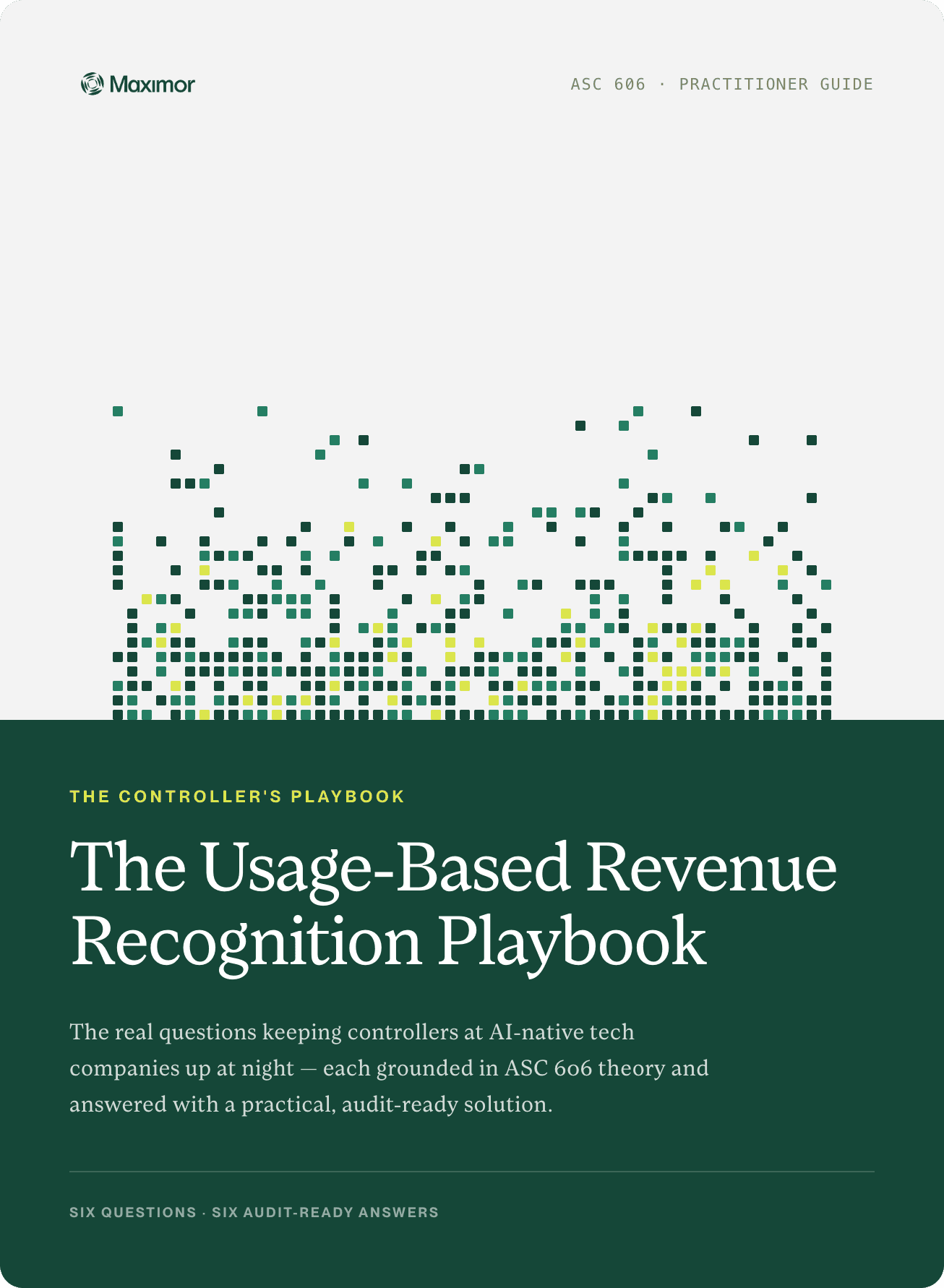
MXMaximorThe controller’s playbook · ASC 606
The usage-based revenue recognition playbook
Get started

Your path to autonomous finance starts here.

We start by mapping how your company works, with no documentation project required. And we price for real outcomes, not seats.

Book a call