The Metrics Investors Trust Least In Consumption Businesses


Snowflake tells its own investors not to read too much into its contracted-revenue number. The company discloses that its remaining performance obligations are not necessarily indicative of future product revenue. The figure cannot see when customers will consume, or whether they will run past the capacity they committed to. When a company has to warn the market away from its own backlog metric, the standard software scorecard is not measuring what it used to.
The accelerant is AI pricing. Revenue metered in tokens, drawn down from prepaid credits, or tied to usage events does not arrive on the calendar a subscription would set. The amount a customer generates each quarter is decided by what they consume, not by what they signed. That single shift strains the three metrics investors have leaned on for a decade: annual recurring revenue, remaining performance obligations, and net revenue retention.
It does not strain them uniformly, and the honest version of this story is more useful than "the metrics are broken." Some usage-influenced companies report ARR with a carefully disclosed definition. The purest consumption players decline to. Remaining performance obligations still capture the committed floor, but by design they leave out the usage that drives growth. Net revenue retention stays meaningful, but it starts measuring something different. This piece maps which metrics hold, which bend, and what the balance sheet shows that the operating metrics miss.
A diagnostic for the metric stack
Before redefining anything, a CFO needs to know where each metric sits relative to how revenue is invoiced and how it is recognized. The gap between those two is where consumption pricing does its damage to a reported number. The table below is the fast read.
Metric | What it was built to measure | Where consumption strains it | First move |
ARR | A contractually recurring annual amount | No recurring amount to annualize, so a run-rate is an estimate | Report only with a disclosed definition, or use a consumption-native metric |
RPO | Contracted revenue not yet recognized | Usage falls out through four distinct mechanisms, not one blanket exclusion | Present with commentary on what is excluded, not as total future revenue |
Net revenue retention | Cohort expansion and contraction over a year | Expansion and churn have no discrete event to anchor to | Publish the definition, the window, and how churn is defined |
Balance sheet contract balances | Where revenue sits in the earn-and-bill cycle | Breakage recognition is embedded in the drawdown and must be separated out | Build them into the monthly package with the correct labels |
Each row below explains the strain and the fix.
ARR in a consumption model: contested, not forbidden
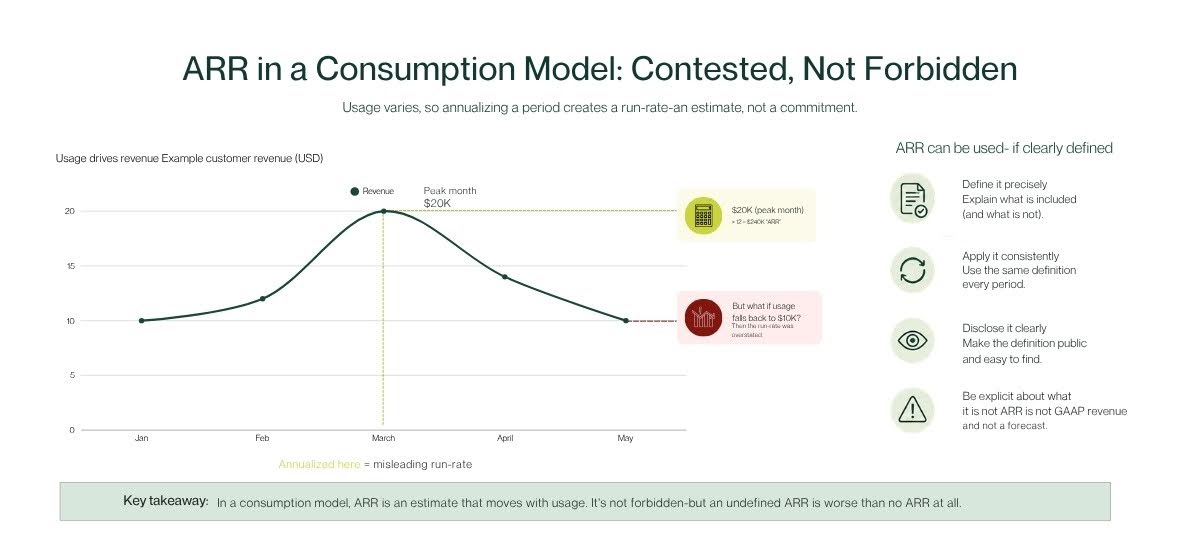
ARR was designed for recurring subscriptions. In a pure consumption model, there is no contractually recurring amount to annualize. A run-rate built on last quarter's usage is an estimate, not a commitment. If last quarter was a peak, the run-rate overstates. If it was a trough, it understates. The number moves with consumption, which is exactly what a commitment metric is not supposed to do.
That is a real limitation, but the common claim that consumption companies simply do not report ARR is false, and the accurate version matters. The purest consumption players decline to report it. Snowflake and Twilio present consumption-native metrics instead. Snowflake leads with product revenue growth, net revenue retention, and the count of customers with trailing-12-month product revenue above $1 million. Twilio reports a dollar-based net expansion rate.
Other usage-influenced companies do report ARR, with an explicitly disclosed definition. Datadog defines ARR as monthly run-rate revenue multiplied by 12, and its monthly run-rate deliberately folds in committed contractual amounts, additional usage, and monthly subscriptions. It also tells investors plainly that ARR is not GAAP revenue and is not a forecast of revenue. JFrog defines ARR as the annualized run-rate of subscription agreements as of the last month of the quarter. It reports customer bands at $100,000 and $1 million of ARR every period.
So the takeaway for a CFO is not "never report ARR." It is narrower and more demanding. If you report it, define it precisely, disclose the definition, apply it consistently, and be explicit about what usage is or is not inside it. In a consumption context, the definition is doing all the work, so an undefined ARR is worse than no ARR at all.
RPO: what it captures, and why usage falls out of it
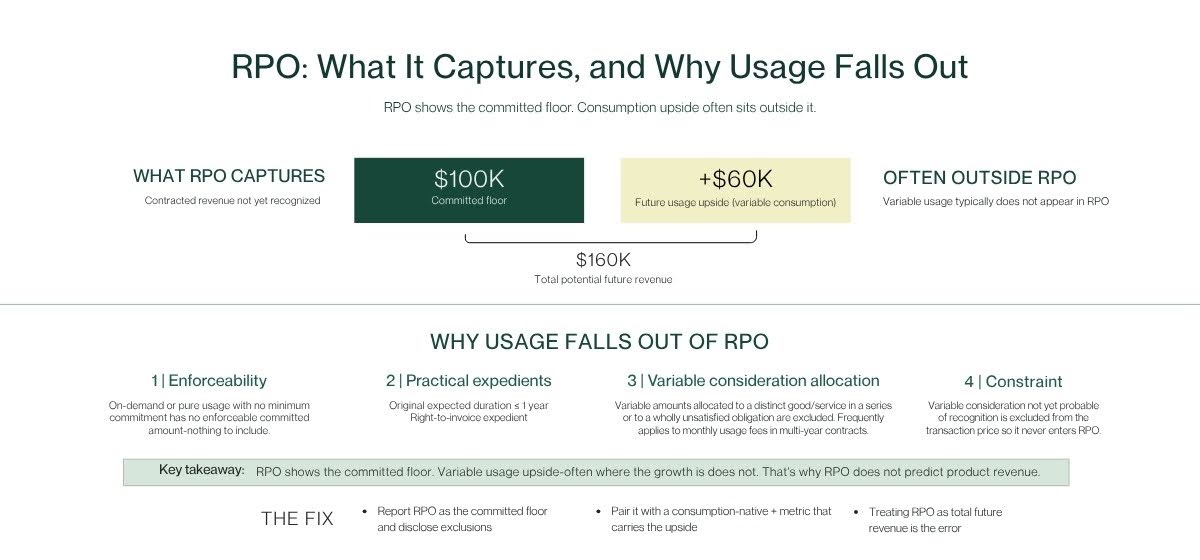
Remaining performance obligations represent contracted revenue not yet recognized. The figure includes deferred revenue and non-cancelable committed amounts to be invoiced in future periods. It is a genuine measure, and it is useful, but consumption revenue generally drops out of it. The reason is not a single blanket rule that variable consideration is excluded. It is a set of specific mechanisms a CFO should be able to name.
The first mechanism is enforceability. On-demand and pure usage arrangements with no minimum purchase commitment carry no enforceable committed amount, so there is nothing to include. Snowflake's own disclosure states that its RPO excludes on-demand arrangements for exactly this reason.
The second is a pair of practical expedients. One lets a company omit the disclosure for performance obligations with an original expected duration of one year or less. The other, the right-to-invoice expedient, lets a company that recognizes revenue in the amount it has the right to invoice omit that portion.
The third is the mechanism that matters most inside a committed contract, and it is the one usually left out. Where variable consideration is allocated entirely to a distinct good or service in a series, it is exempt from the disclosure. The same applies when it is allocated to a wholly unsatisfied performance obligation. A monthly usage fee inside a multi-year commitment typically qualifies. This is why usage can fall out even when the contract itself is committed, not just when it is on-demand.
The fourth is the constraint. Variable consideration constrained as not yet probable of recognition never enters the transaction price to begin with. So it is not in the figure at all.
The consequence is the same in each case. The committed floor shows up in RPO. The variable usage upside, which is often where the growth is, does not. That is why Snowflake warns that RPO does not predict product revenue. The number cannot see the timing of consumption, or the usage that runs past contracted capacity.
The fix is presentation, not suppression. Report RPO, but frame it as the committed floor and say which exclusions apply. Pair it with the consumption-native metric that carries the upside the floor cannot. Treating RPO as total future revenue is the error, whether that overstates or understates the real trajectory.
Net revenue retention: still useful, but measuring something different

In a subscription model, net revenue retention compares a cohort's contract value across a year and cleanly separates expansion, contraction, and churn. Each of those is a discrete event: an upsell, a downgrade, a cancellation. In a consumption model, none of them is discrete. A customer simply consumes more or less, and the metric has to infer expansion and contraction from the swing.
Net revenue retention remains meaningful, and consumption companies report it. Snowflake's sat near 125% as of October 31, 2025. But two things change, and both need disclosure. First, the definition has to specify how consumption changes are measured and over what window. A customer that spikes in one period and falls in the next can flatter expansion and then overstate contraction. The window is not a footnote. It is part of the number. Second, churn has no cancellation event. A consumption customer rarely signs a termination. The company has to define churn itself, for example as zero consumption across a set number of consecutive periods, and disclose that definition.
The practical guidance is to keep reporting net revenue retention, but publish the definition and the window beside it, and be ready to explain both. A retention figure without its definition invites the reader to assume a subscription meaning that no longer applies.
The balance sheet signals the operating metrics miss
For consumption businesses, the leading indicators with audit-quality evidence behind them sit on the balance sheet. They only help if they are named correctly, and this is where loose language does real harm.
Deferred revenue is a contract liability. It moves as customers prepay for credits and draw them down. The drawdown is not a clean read on consumption, though, because it blends two things. Part is actual consumption. Part is breakage, the revenue a company recognizes on credits it expects the customer never to use. Breakage runs opposite to consumption, so a drawdown presented as pure usage flatters hardest exactly when customers are using the least. The two have to be separated before the balance signals anything. One screen sits underneath all of this. Amounts the company must remit under unclaimed property law stay a liability and never become revenue. A contract asset is different. It arises when a company has recognized revenue but its right to payment is still conditional on something other than the passage of time. That is common when usage has been earned but not yet billed under the contract's schedule. A receivable is different again. It is an unconditional right to payment, where the only thing left is the passage of time, typically once an invoice has gone out.
The distinction between a contract asset and a receivable is not pedantic. A contract asset carries performance risk as well as credit risk, because something other than time still stands between the company and payment. A receivable carries credit risk only. Collapsing the two into a single "unbilled receivable" line hides that difference and blurs the signal. Read separately, they tell three different stories. A rising prepaid credit drawdown, net of breakage, signals accelerating consumption. A growing contract asset balance signals usage being earned ahead of billing. Receivable aging signals collection timing. The underlying balances are audited to a materiality threshold, and these indicators inherit that discipline. The drawdown itself is a management-defined cut of the contract liability, not an audited figure on its own. Even so, indicators grounded in audited balances are more trustworthy than operating metrics built on top of them.
What the SEC has actually asked about consumption-metric disclosure
The best guide to what will survive review is the review itself. A search of SEC comment letters on operating-metric and non-GAAP disclosure shows the staff returning to a consistent set of questions. The pattern is instructive for any consumption-model registrant.
The staff asks companies to define how a retention metric is calculated and to disclose the figure for every period presented. In one letter, the staff pressed a software company to define its dollar-based net retention rate. The staff also asked whether renewal and retention rates were key metrics the company managed the business by. The staff asks companies to define ARR and to be specific about what is inside it. In another, the staff questioned a company's ARR disclosure. The company responded by expanding its definition to spell out which contract types the figure included. On non-GAAP measures, the recurring theme is prominence and reconciliation. Several companies received comments for presenting an adjusted measure more prominently than the comparable GAAP figure, or without a quantitative reconciliation.
Read together, the letters point to one expectation. If you disclose a metric, define it, show how it is calculated, keep it consistent, and reconcile it to GAAP where the rules require. Vagueness is what draws the comment.
Operating metric or non-GAAP measure: two different rulebooks
The governing rules sit in two places, and conflating them is a common error. Operating metrics such as ARR and net revenue retention are not non-GAAP financial measures, because the rules exclude operating and statistical measures from that definition. They fall under the SEC's guidance on key performance indicators in management's discussion and analysis. That guidance expects a clear definition and a statement of why the metric is useful. It also expects a statement of how management uses the metric, and disclosure of any change in how it is calculated. Genuine non-GAAP financial measures, such as adjusted operating income, fall under Regulation G and the related item of Regulation S-K. Those rules require the comparable GAAP measure with equal or greater prominence, a quantitative reconciliation, and a statement of why the measure is useful. There is no staff accounting bulletin governing non-GAAP measures. Knowing which regime a given number sits in is the difference between a clean filing and a comment letter.
Building a metric stack that survives the board deck, the S-1, and the audit
The same metric has to serve three audiences with three different tolerances. The board wants a directional signal. An S-1 requires a defined, consistently applied, reconcilable measure. The audit tests the GAAP figures underneath. A metric that is fine for the board can fail the other two, so it helps to see the whole stack at once.
Context | What it needs from a metric | What breaks it |
Board deck | A directional read on the business | An undefined number nobody can reproduce next quarter |
S-1 | A defined, consistent, reconcilable measure | A definition that shifts, or one that cannot tie to GAAP |
Audit | The underlying GAAP figures | Operating metrics with no traceable link to the ledger |
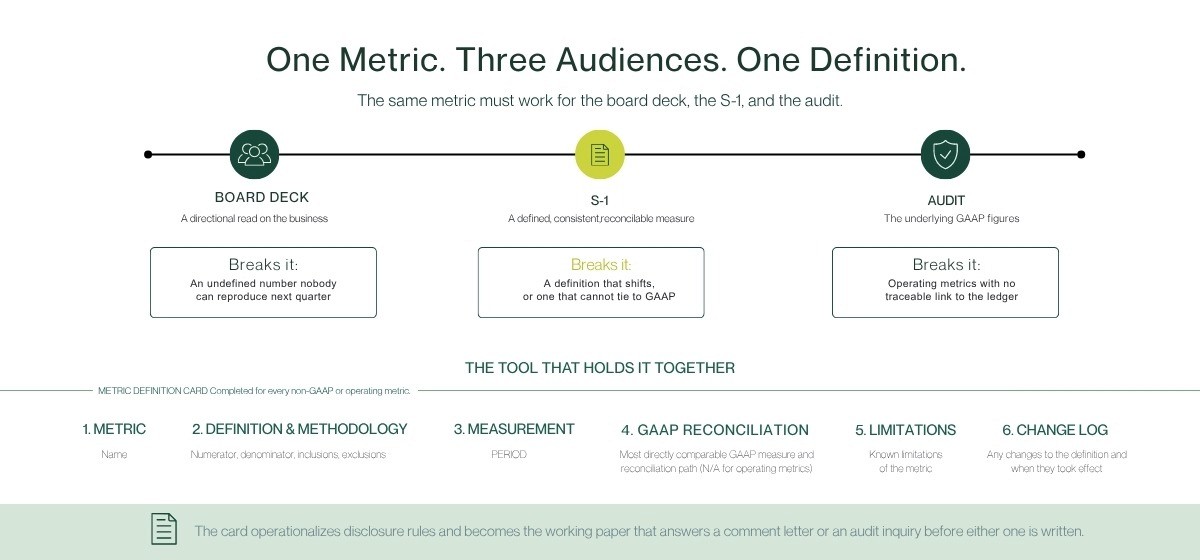
The tool that holds this together is a metric definition card, completed once for every non-GAAP or operating metric the company reports. It records the metric name, the precise definition, and the calculation methodology, meaning the numerator, the denominator, and every inclusion and exclusion. It records the measurement period. For any metric that is a non-GAAP financial measure, it records the most directly comparable GAAP measure and the path to reconcile to it. For an operating metric, which carries no such requirement, that field is marked not applicable. It records known limitations. And it records a change log that captures any change to the definition and when it took effect. The card is not paperwork. It operationalizes the disclosure rules and becomes the working paper that answers a comment letter or an audit inquiry before either one is written.
A CFO's action plan for consumption metric governance
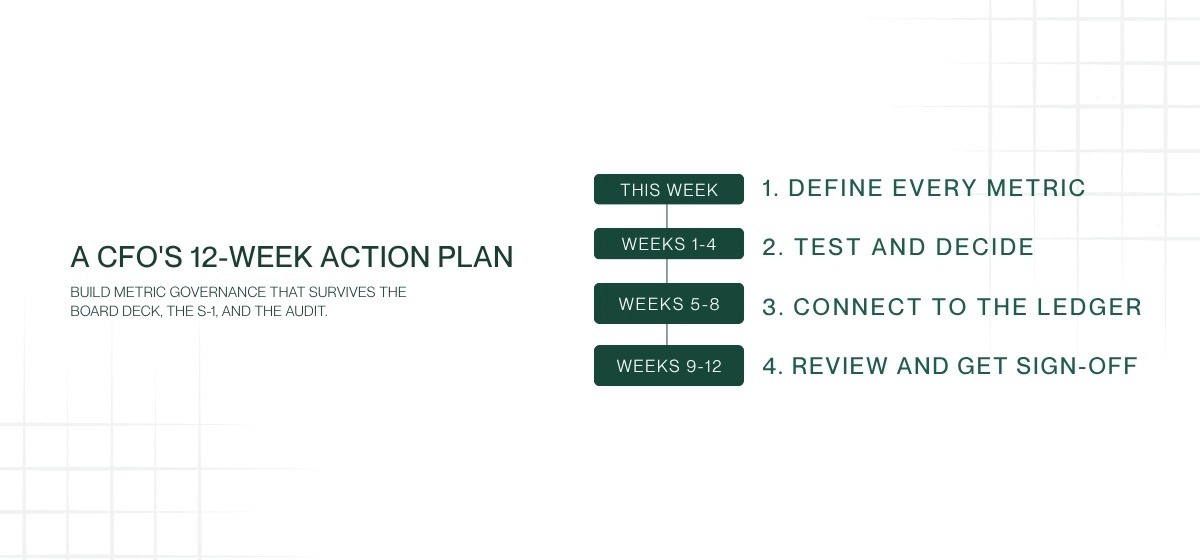
This week. For every non-GAAP or operating metric reported to the board, complete the metric definition card. Any field you cannot fill is a gap to close before the next reporting cycle. The output is a completed card per metric and a list of gaps.
Weeks 1 to 4. Identify which metrics bend under consumption assumptions, starting with ARR if you report it, net revenue retention, and RPO commentary. For each, choose one of three paths at a documented gate. Redefine the metric with a consumption-appropriate definition. Supplement it with the GAAP measure that restores the missing context. Or replace it with a consumption-native metric such as product revenue growth or trailing-12-month revenue bands. The output is a decision on the record for each metric.
Weeks 5 to 8. Build the balance sheet indicators into the monthly reporting package: prepaid credit drawdown, contract asset trend, and receivable aging, each labeled with the correct term. Use them to pressure-test the operating metrics, and flag any metric the balance sheet does not support. The output is a monthly package that reconciles the operating story to the ledger.
Weeks 9 to 12. Review the full metric stack with external counsel or the audit firm against the applicable disclosure rules before the next board and reporting cycle. Bring the metric definition cards as the working papers. The output is a sign-off, or a punch list to clear before the next filing.
Where a reconciled source changes the math
Every step above assumes the underlying numbers come from one place and mean the same thing each period. In most finance functions, they do not. The prepaid credit drawdown lives in the billing system, the contract asset movement in the subledger, and the receivable aging somewhere else again. Each gets rebuilt by hand every close.
Maximor's reporting and insights product line lets the team query across connected finance and operations systems in natural language. The balance sheet indicators that actually lead consumption revenue then surface from one reconciled source, rather than being reassembled from separate subledgers each period. The metric definitions a CFO commits to can then be applied consistently, because the numbers behind them come from the same place every time. That consistency is what turns a defined metric into a defensible one.
See your metric stack reconciled to the ledger. Book a walkthrough.
Frequently asked questions
Do usage-based companies report ARR?
Some do, and some do not, and the split is telling. The purest consumption players, such as Snowflake and Twilio, decline to report ARR. They lead with consumption-native metrics like product revenue growth and net expansion rate. Usage-influenced companies such as Datadog and JFrog do report ARR, but with an explicitly disclosed definition that specifies what usage is inside it. In a consumption model, the definition carries the number, so an undefined ARR is the real problem, not ARR itself.
Why is usage revenue excluded from remaining performance obligations?
Two reasons, and one is easy to miss. Some usage is not a committed amount, so on-demand arrangements with no minimum purchase commitment carry no enforceable obligation to include. Beyond that, practical expedients let companies omit short-duration obligations and amounts recognized at the value they have the right to invoice. And usage billed as variable consideration allocated to a series is exempt even inside a committed multi-year contract. The result is that RPO captures the committed floor and leaves out the variable usage upside. That is why it should be read as a floor, not as total future revenue.
How is net revenue retention measured in a consumption model?
It compares a cohort's revenue across two periods. But in consumption, there is no discrete upsell or downgrade to anchor to, so the definition has to do more. It must specify how consumption changes are measured and over what window, because a spike followed by a fall can distort both expansion and contraction. It must also define churn, since a consumption customer rarely signs a cancellation, often as zero consumption across a set number of consecutive periods.
What rules govern non-GAAP metrics in SEC filings?
It depends on what kind of measure it is. Operating metrics such as ARR and net revenue retention are not non-GAAP financial measures. They fall under the SEC's guidance on key performance indicators. That guidance expects a clear definition, why the metric is useful, how management uses it, and disclosure of any change in calculation. Genuine non-GAAP financial measures such as adjusted operating income fall under Regulation G and the related Regulation S-K item. Those rules require the comparable GAAP measure with equal or greater prominence, a quantitative reconciliation, and a usefulness statement.
What is the difference between a contract asset and a receivable?
A contract asset is a right to payment still conditional on something other than the passage of time, usually because more performance is required. It carries both performance risk and credit risk. A receivable is an unconditional right to payment where only time remains, so it carries credit risk alone. Collapsing the two into an "unbilled receivable" line hides that difference. That matters, because the two tell different stories about where revenue sits in the earn-and-bill cycle.
What balance sheet signals lead consumption revenue?
Three, and all trace to balances the auditor audits to a materiality threshold, so the indicators inherit that discipline. A rising drawdown of prepaid credit balances, once breakage is separated out, signals accelerating consumption. A growing contract asset balance signals usage being earned ahead of billing. Receivable aging signals collection timing. Read together and labeled correctly, they lead the operating metrics and are harder to distort. They trace directly to the ledger, rather than sitting on top of it.