The Allocation Problem Hiding in Hybrid AI Contracts


Nearly every AI company that launched on pure usage pricing has drifted into hybrid contracts. A committed platform fee. Usage tiers. A prepaid pack of tokens or credits. An add-on module or two. Recognizing each element on its own is manageable. Allocating the transaction price across the bundle is where the hard judgments live, and where an auditor spends their time.
The reason is structural. How each element is invoiced is not how the bundle is recognized. A platform fee bills monthly. Tokens meter by volume. Credits draw down as they are used. Allocation, the fourth step of the revenue model, decides how much of the total price attaches to each promise. In consumption contracts, it is the least automated step, because it turns on estimates most billing systems never make.
Why allocation is the hardest step in consumption contracts
In a pure subscription, allocation is close to mechanical. Each element has a list price. The discount spreads in proportion to the standalone selling price. The math follows.
A hybrid consumption contract breaks that pattern in three ways at once. At least one element carries variable consideration. At least one has no observable standalone selling price. And the bundle may contain an option that qualifies as a separate promise in its own right.
Consider a contract that bundles a platform license, a prepaid token credit pack, professional services for model fine-tuning, and a usage rate for overage. Each piece raises its own allocation question, and the questions interact. Get one wrong and the whole allocation shifts.
Estimating standalone selling price when there is no observable price
Allocation runs on standalone selling price, the price at which you would sell each element separately. When you sell an element on its own, the observable price is the best evidence. When you do not, you estimate it, and you maximize the observable inputs you do have. A list price can inform the estimate, but it is not automatically the standalone selling price.
The standard describes three estimation methods, set out below.
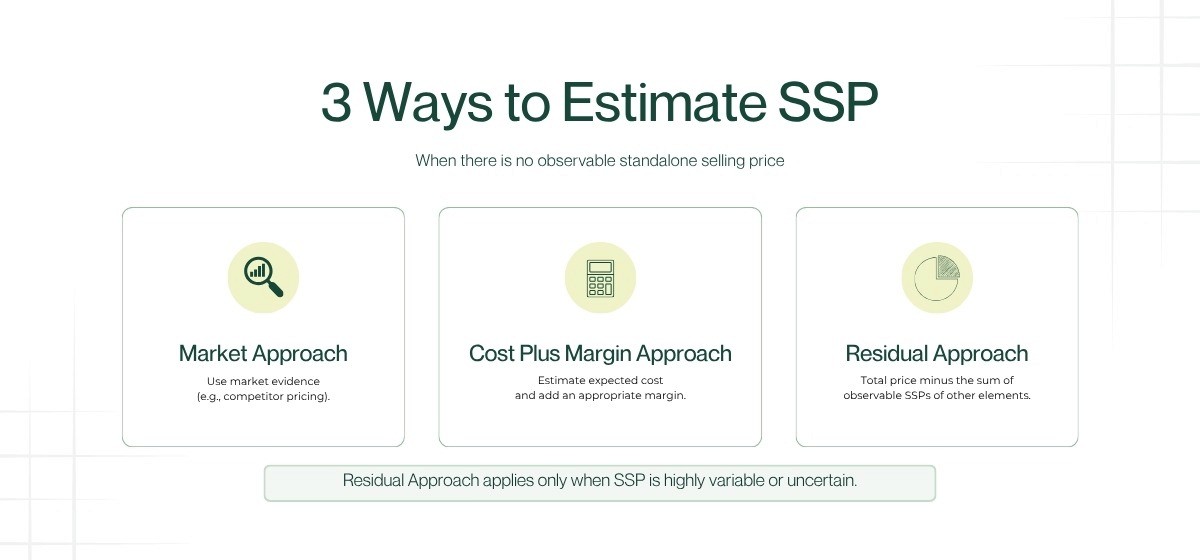
Adjusted market assessment
This method looks outward, to the market. You estimate the price a customer in that market would pay. You can reference competitor pricing for similar offerings and adjust for your own costs, margins, and position.
One clarification matters, because it is easy to get backwards. Where you have a meaningful population of your own standalone sales to similar customers, that is the primary evidence of standalone selling price. A tight population is a directly observable price, not an estimate at all. This method is the fallback for when those own-sale observations are thin or absent. It looks to what the market pays, drawing on competitor rate cards, third-party benchmarks, and any observed prices you do have. The team then documents the reasoning behind the estimated price or range.
Expected cost plus a margin
Here you forecast the cost of satisfying the obligation and add an appropriate margin. It fits professional services and implementation, where the cost base is knowable. For fine-tuning billed by the hour, cost times a blended rate plus margin is easy for an auditor to tie out.
It fits metered usage less well. The margin on a token or an API call is set by competitive pricing, not by compute cost. A cost-plus build rarely lands where the market prices the usage.
The residual approach
The residual estimates one element's standalone selling price as the total price less the sum of the observable standalone selling prices of the other elements. It is the method most reached for and most misapplied, so its conditions matter.
It is permitted only when the element's standalone selling price is highly variable or uncertain. Highly variable means the same item sells across a broad range of prices with no representative point. Uncertain means no price has been set and the item has never sold on its own.
Two conditions are easy to miss. First, the contract must contain at least one other element with an observable standalone selling price. The residual is only what remains after subtracting observable prices. Second, the result has to survive a check against the allocation objective. A residual that assigns almost nothing, or a clearly unreasonable amount, to a material element signals the method does not fit. That holds even when the variability condition is met.
On rate cards, be precise, because two separate conditions are in play. A published price list speaks to the uncertain prong. It shows a price has been set and the item is offered on its own, which points away from uncertain. It says almost nothing about the highly variable prong. That prong turns on the range of amounts you actually transact at, not on the existence of a list. A list price may be, but shall not be presumed to be, the standalone selling price. The facts can rebut it either way. Where two or more elements are both highly variable or uncertain, the residual can estimate their combined standalone selling price. Another method then splits it between them.
When a discount belongs to one obligation
A discount in a bundle is allocated proportionally across every obligation on relative standalone selling price. The exception is narrow. If there is observable evidence that the discount relates entirely to one or more, but not all, of the obligations, it is allocated there instead.
In consumption contracts, this comes up when a platform fee is discounted to win a usage commitment, or the reverse. The evidence bar is specific. You regularly sell each element on its own. You regularly sell some bundle of them at a discount. And that bundle discount is substantially the same as the one in the contract. One sequencing rule matters. Where a discount is allocated to specific obligations, that step happens before you apply the residual approach. Otherwise the discount leaks into the residual element.
The variable consideration allocation exception
Variable consideration is normally spread across the bundle like any other amount. There is an exception, and in consumption contracts it is the one that does the most work.
You may allocate a variable amount entirely to a single obligation, rather than spread it, only when both conditions hold. The variable payment must relate specifically to your efforts to satisfy that obligation. And allocating the entire amount there must be consistent with the allocation objective, considering every obligation and the payment terms together.
A usage overage layer often fits. The overage relates specifically to the usage the customer draws, so it is recognized as that usage occurs rather than smeared across the platform fee. When variable consideration attaches this way to a future period, you often do not need to estimate the full-term total at inception. It does not fit when the platform fee effectively subsidizes the usage rate, because then the variable payment is not specific to the usage obligation.
One distinction to keep clean. This is an allocation question in Step 4. The constraint on variable consideration is a measurement question in Step 3. Where you do estimate variable consideration, the estimate is still limited to the amount that is not probable of a significant reversal. Document the two-condition analysis for every contract with a material overage layer. It is a short memo, not a spreadsheet.
Material rights, and the features that only look like them
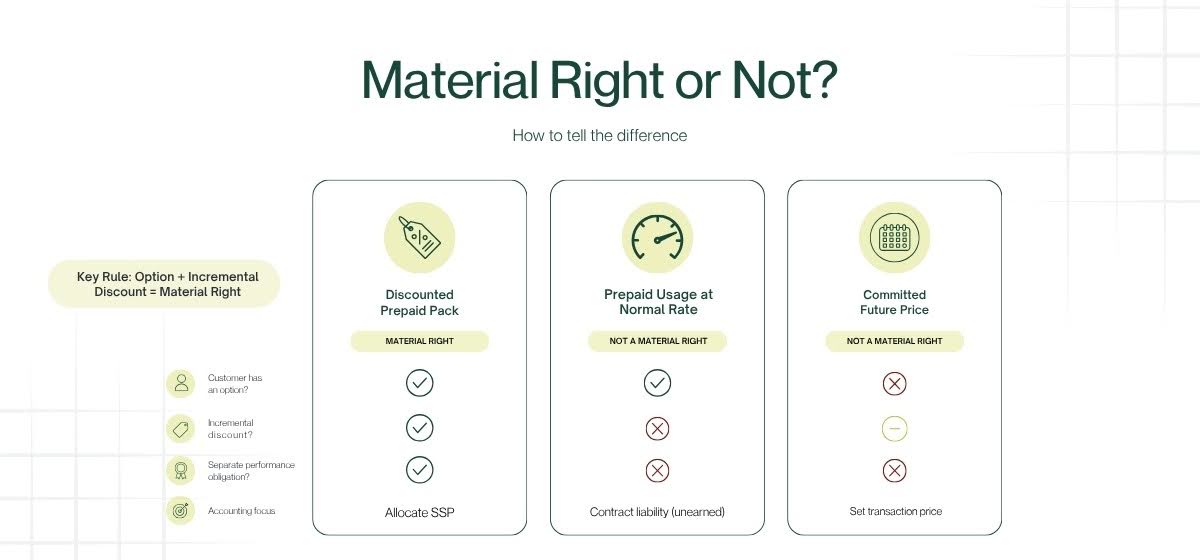
An option to buy more can be a separate promise. Some qualify, some only look like it. Teams make two opposite errors here, so state the test first.
A customer option to acquire additional goods or services is a separate performance obligation only in one case. It grants a material right the customer would not get without signing this contract. The textbook example is a discount incremental to the range typically given for those goods or services. The comparison is to that class of customer in that geographical area or market. The class-of-customer qualifier is not decoration. The comparison is against what comparable customers who did not sign this contract would receive, not against a single universal rate. There is no numeric threshold. It is a judgment against a range.
Discounted prepaid token or credit packs
What it is. An option to consume future usage at a per-token rate below what a comparable customer gets without the commitment. In effect, an advance purchase of a future discount.
How to spot it. Compare the pack's rate to the rates offered to the same class of customer, in the same market, who did not buy the pack. If the pack's discount is incremental to that range, it points to a material right. A pack sold at the customer's normal rate is different. That is prepaid usage, a contract liability drawn down as consumed, not a material right.
How to fix it. Treat the right as a separate performance obligation. Estimate its standalone selling price from the expected discount on future purchases. Adjust for the discount available without exercising and for the likelihood of exercise. Allocate part of the transaction price to it, and recognize as the credits are consumed or the right expires.
Renewal and expansion options
A right to renew or expand below what a comparable new customer would receive can be a material right. Test it the same way. The determinant is whether the discount is incremental for that class of customer, not merely lower than the first-year rate. An option priced at the going standalone rate is not a material right. It is a marketing offer, accounted for only on exercise.
Committed ramped pricing
Committed ramps look like material rights and generally are not. If year two's lower rate is contractually committed rather than optional, the customer has no option to exercise. There is no material right, because the customer is obligated to continue, not choosing to. A committed future price step is a transaction-price question and, potentially, a financing question, not a material-right question. The line to carry is simple. An option creates a material right. A commitment does not.
The financing question hybrid contracts skip
When a customer pays well ahead of delivery, or a multi-year deal front-loads or back-loads payment, the contract may contain a significant financing component. That would mean separating interest from revenue. In hybrid consumption contracts, prepaid credit packs and multi-year ramps are the classic triggers, and the assessment is often skipped.
The intuitive answer is frequently wrong, so reason it through. A financing component is generally not significant, even with a large prepayment, when the customer controls the timing of delivery. Prepaid usage credits that the customer draws down at its own discretion usually sit here. Many credit packs carry no significant financing component despite the upfront cash. Two further reliefs apply. There is a practical expedient where the gap between payment and delivery is expected to be one year or less at inception. It is applied consistently and disclosed. And there is an exclusion where a substantial part of the consideration is variable and turns on a future event outside either party's control.
The point is not that credit packs never carry financing. A prepaid right the customer can exercise only at a fixed future date, with no discretion over timing, can. The point is that the assessment is required for credit packs and multi-year ramps. For customer-discretion prepayments, the usual answer is no significant financing component. That answer has to be reached and documented, not assumed.
Minimum commitments with overage
The most common hybrid structure is a committed minimum with usage overage above it. Two treatments are defensible, and one question decides between them.
Either the committed minimum attaches to the platform or usage obligation, with overage treated as a distinct variable element recognized as it occurs. Or the minimum and overage together form a single obligation satisfied over time and recognized as the service is consumed. The determinant is whether exceeding the commitment delivers a distinct promise or simply more of the same service. A second factor is whether the overage rate differs from the committed rate.
One recognition trap sits underneath. Suppose the effective rate declines as volume rises. Recognizing at a single blended average rate can then pull revenue forward or push it back, away from the rate the customer actually pays. The pattern has to reflect the rate structure, or the period figure overstates or understates. This ties back to the allocation exception above, because the two analyses move together.
The reassessment rule teams get backwards
There is no requirement to reassess standalone selling price on a fixed annual cycle. That invented rule sends teams looking for work the standard does not ask for. Standalone selling price is estimated at contract inception, and the inception estimate drives that contract's allocation.
The rule teams actually get wrong is the flip side. When your standalone selling price changes later, you do not go back and reallocate the transaction price of existing contracts. A later change flows to new contracts signed after it, not to the allocation locked at inception on prior deals. The exception is a qualifying contract modification, which can reset the allocation for the remaining obligations.
What does deserve ongoing attention is method fit. A residual approach that fit at launch can stop fitting once standalone sales exist and a price becomes observable. So reconsider the method for new contracts as evidence accumulates. Tie that review to pricing changes and to new observable data, not to a calendar.
A diagnostic checklist for hybrid AI contracts
Run this against the portfolio, one row per contract element. It surfaces the gaps an auditor tends to find first.
Contract element | SSP method used | Observable price? | Material right for this class of customer? | Overage two-condition memo done? | Financing component assessed? | Documented at inception? |
Platform license | Yes / No | Yes / No | n/a | Yes / No | Yes / No | |
Prepaid token or credit pack | Yes / No | Yes / No | n/a | Yes / No | Yes / No | |
Professional services, fine-tuning | Yes / No | Yes / No | n/a | Yes / No | Yes / No | |
Usage overage | Yes / No | n/a | Yes / No | Yes / No | Yes / No |
An action plan for the head of technical accounting
This week. Pull the five largest hybrid contracts by transaction price. For each, confirm the standalone selling price is documented at inception, which method was used, and whether that method still fits current evidence for new contracts. Decision gate: any contract missing inception documentation is the first thing to remediate.
Weeks 1 to 4. Inventory every credit pack, renewal, and expansion option across the portfolio. Test each against the material-right standard using the class-of-customer comparison. Output: a workpaper that separates genuine options from committed terms that are not options. Decision gate: each identified material right needs a standalone selling price and an allocation before the next close.
Weeks 5 to 8. For every contract with a material overage layer, document the two-condition variable consideration analysis. For every prepaid credit pack and multi-year ramp, document the financing component assessment and its conclusion. Decision gate: no material overage or prepayment enters the close without a documented conclusion.
Weeks 9 to 12. Connect standalone selling price method review to the pricing team's release calendar. The method is then reconsidered for new contracts when pricing or observable data changes. Confirm the team is not reallocating prior contracts for later standalone selling price shifts. Decision gate: a standing checkpoint tied to pricing releases, not to an annual date.
Where this leaves the close
Allocation resists templating. It runs on judgment a billing system was never built to hold. The methods are knowable. The hard part is capturing the reasoning at inception and applying it the same way across a portfolio. Then you hold it steady as later pricing changes tempt a drift.
Maximor's revenue recognition product automates the contract-to-revenue workflow, including standalone selling price estimation and allocation. It learns from the work the team already produces rather than waiting for rules to be configured from scratch. For hybrid contracts where the allocation judgment is dense, it captures that judgment at inception and applies it consistently across the portfolio. It holds the inception allocation in place instead of drifting as prices move. The judgment stays yours. The engine that applies it at scale is the platform's.
See how the allocation holds up on your own contracts. Book a revenue automation walkthrough.
Frequently asked questions
What is standalone selling price under ASC 606?
Standalone selling price is the price at which you would sell a promised good or service separately to a customer. The best evidence is the observable price when you actually sell it on its own. When that does not exist, you estimate it and maximize observable inputs. A list price can inform the estimate, but it is not automatically the standalone selling price.
When is the residual approach allowed for estimating SSP?
Only when the element's standalone selling price is highly variable or uncertain. The contract also needs at least one other element with an observable standalone selling price to subtract from the total. Even then, the result must be reasonable against the allocation objective. A residual that assigns an implausible amount to a material element means the method does not fit.
When can variable consideration be allocated to a single performance obligation?
When both conditions hold. The variable payment relates specifically to your efforts to satisfy that obligation. And allocating the whole amount there is consistent with the allocation objective across all obligations and payment terms. A usage overage layer often qualifies, so it is recognized as the usage occurs rather than spread across the bundle.
When does a prepaid credit pack create a material right?
When the pack's rate is incremental to the range offered to comparable customers, in the same market, who did not buy the pack. If the pack simply prepays usage at the customer's normal rate, it is a contract liability drawn down as consumed, not a material right. There is no numeric threshold. It is a judgment against a range.
Do prepaid usage credits create a significant financing component?
Usually not, when the customer controls the timing of drawdown. Prepaid credits drawn at the customer's discretion generally do not carry a significant financing component despite the upfront cash. The assessment is still required. The answer changes if the customer can use the prepayment only at a fixed future date, with no discretion over timing.
If our SSP estimate changes, do we reallocate existing contracts?
No. Standalone selling price is set at inception, and you do not reallocate prior contracts for later changes. Updated estimates apply to new contracts signed after the change. A qualifying contract modification is the exception, since it can reset the allocation for the remaining obligations.